for TOTAL R-CALCS, Building Heating and Cooling Energy, Insulation, Equipment Testing, R&D, Thermal Investigations |
for TOTAL R-CALCS, Building Heating and Cooling Energy, Insulation, Equipment Testing, R&D, Thermal Investigations |
| James M Fricker Pty Ltd provides a variety of services. For graphical examples and case studies, click here. For text examples and case studies, click here.
NOTE:
All test reports are available in secure Acrobat PDF files for your ease of use.
Details
|
|
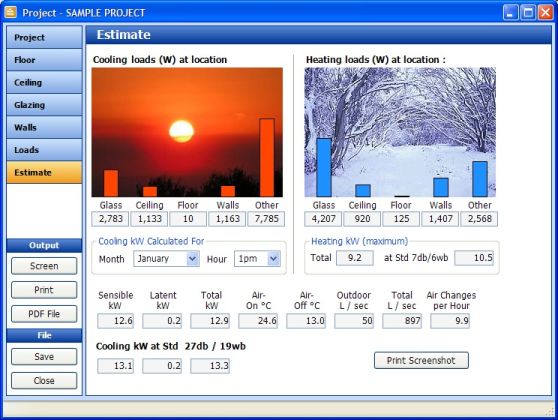
 AirConditioning Load Estimation Software, for info click here (CoolEst helps reveal the affect of varying insulation on airconditioning load.) Summary of other Testing and Consulting Services: |
Last edited: 25 Nov 2025
INSULATION TYPES AND PROPERTIES
AIR SPACES are also insulators but their resistance is not proportional to their thickness. This is because RADIATION and CONVECTION heat transfer can dominate CONDUCTION, thus their thermal resistance varies widely depending on the application conditions (orientation, bounding temperatures, ventilation, heat flow direction, air gap, air volume shape). Thus Material R varies widely and the appropriate thermal property is Total R for specific conditions set in AS/NZS 4859.1:2002.
REFLECTIVE AIR SPACES that prevent heat flow downwards are particularly good insulators as the direction of heat flow eliminates convection, the reflective surface prevents radiation, and still air is an excellent insulator (conductivity 0.026W/m.K).
Home insulation specification should directly relate to building performance as the target is minimum heat transfer through building surfaces. The measure for this is Total R as defined by AS/NZS 4859.1:2002 - (Materials for the thermal insulation of buildings - Part 1: General criteria and technical provisions). It is the total thermal resistance through the building surface, including all the material layers and air spaces through the section, plus the indoor and outdoor air film resistances.
The specification of just Material R (bulk insulation) is very limiting as it excludes the cost-effective benefits of reflective insulation.
Often the most cost effective home insulation is a combination of reflective insulations and bulk insulations.
Dense solids have packed molecules, so thermal conduction is higher than through contained gases. Dense solids have much lower thermal resistance than an equal air space. Still air is thus classified as a thermal insulator.
But when the air is turbulent, there is very significant heat transfer (e.g. wind chill in an antarctic blizzard). The air must be still to be a good insulator.
When there are buoyancy effects or forces moving fluid particles, there may be significant heat transfer by CONVECTION. (e.g. Water gently heated at the base of a saucepan rises to the surface, cools, then moves down near the perimeter in a toroidal motion. e.g. Attic air warmed through an uninsulated ceiling buoyantly rises and is lost into the winter night, adding to heating bills.)
A REFLECTIVE surface reduces radiative heat transfer, so the cavity adjacent the reflective surface becomes REFLECTIVE INSULATION.
For a sealed roof attic, conduction and convection may be low, so radiative heat transfer may dominate. In such cases, the addition of a Reflective Foil Laminate (RFL) will almost eliminate the radiative heat transfer, so the AIR-GAP becomes a REFLECTIVE INSULATING AIR SPACE.
The RFL may be only 0.1mm thick and have a material R-value of just 0.001 m²•K/W, but its presence transforms the adjacent air space into REFLECTIVE INSULATION. Thus, the RFL ALONE is not reflective insulation (despite it being commonly claimed). It is the RFL+AIR GAP that makes REFLECTIVE INSULATION.
The RFL ALONE might be R0.001, but the RFL+AIR GAP might be R2.0! (The air gap without the RFL might be just R0.15)
REFLECTIVE BUBBLE WRAP has a material R value of perhaps R0.2 across its several millimetres thickness. This adds to the insulation benefit. e.g. REFLECTIVE BUBBLE WRAP+AIR GAP might be R2.2!
Also-
The ONLY additional R-value due to the presence of a REFLECTIVE surface is that due to the AIR-GAP becoming REFLECTIVE. That R is a property of the air gap - without the air gap, there is no reflective benefit!
By an air gap being reflective, the reduced infrared emittance reduces radiative heat transfer across the air gap, and the smaller the AIR-GAP, the more dominant is the unavoidable conductive heat transfer. (The only exception is where there is zero conductive heat transfer because of a total vacuum.)
e.g. 5mm of air conduction (excluding convection and radiative heat transfer) has R0.19. Include radiation and thermal resistance might drop to R0.17 (reflective), or R0.10 (non-reflective)
e.g. 2mm of air conduction (excluding convection and radiative heat transfer) has R0.08. Include radiation and thermal resistance might drop to R0.07 (reflective), or R0.05 (non-reflective)
These Rs are tiny because the air gap is small.
Added Rs can be significant with reflective air gaps of 20 to 40mm for walls (summer and winter), and 100mm+ for floors (winter) and ceilings (summer). Variations (e.g. roof slope) may promote convection currents within the air space and reduce cavity R.
My professional specialty is state-of-the-art calculation of air gap insulation by R&P iterative calculations, and preparation of reports for building insulation certification.
© James Fricker 2010-2025